

ECCJ held the FY2025 energy conservation training program in Japan (ECAP37) for ASEAN countries
<Training program>
Under the instruction and financial support of the Agency for Natural Resources and Energy (ANRE), the Energy Conservation Center, Japan (ECCJ) is implementing the AJEEP Scheme 5 multilateral energy conservation cooperation project for ASEAN countries. As part of this project, training program was held in Japan with the following contents during the five-day period from November 10 to 14, 2025 for persons in charge of energy efficiency and conservation policy-related departments in the governments of each ASEAN country. In the training program, ECCJ provided support for promoting the development of policies to realize carbon neutrality (CN) for the industrial and transportation sectors in the ASEAN countries.
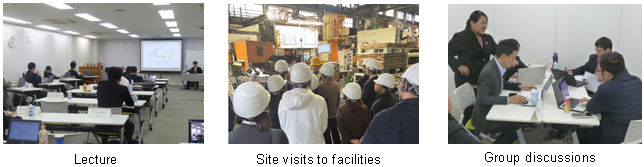
Against the backdrop of global warming becoming an urgent global challenge and the growing demand for policies toward carbon neutrality (CN), Japan has strengthened energy management for business operators through the revision of the Energy Conservation Act. In addition to the rationalization of energy use, measures such as the transition to non-fossil energy sources and the optimization of electricity demand are being implemented. Furthermore, legal frameworks and support measures related to Green Transformation (GX) are being developed, and related specialized institutions and private companies are also promoting initiatives and technological development toward CN.
Through this training program, participants gained an understanding of Japan’s advanced legal frameworks and support measures for CN, with a particular focus on the revised Energy Conservation Act, as well as initiatives undertaken by private companies and the latest information on CN-related policies and institutional frameworks in other ASEAN countries. Participants also discussed the introduction, improvement, and challenges of CN-related policies, legal systems, and support measures in their own countries, and examined draft policy frameworks to be implemented by each country.
As a result, this training program effectively supported capacity-building for participants as policymakers. It also contributed to fostering a business environment conducive to CN-related activities by Japanese companies in the ASEAN region.
[Outline of the training program]
(1) Information sharing on the latest policies, the revised Energy Conservation Act, reporting systems, and support measures for CN in Japan and ASEAN
(2) Introduction of concrete CN initiatives, new technologies, and support measures by Japanese companies and specialized institutions in the industrial sector
(3) Factory visit: Explanation of energy conservation initiatives and corporate plans toward CN at a factory site (automotive parts manufacturing)
(4) Online seminar on the transportation sector (including externally registered participants): Overview of directions and challenges for next-generation vehicles (BEVs), public transportation measures, and case studies on logistics efficiency initiatives by private companies
(5) Discussions by participants on the introduction, improvement, and challenges of CN-related policies and institutional frameworks in their own countries, and the preparation and presentation of draft action plans for new systems
*AJEEP:ASEAN-Japan Energy Efficiency Partnership
Program for building EE&C capacity in the ASEAN region by dispatching experts and implementing training in Japan
ECAP:Energy Conservation Workshop under AJEEP(ASEAN-JAPAN Energy Efficiency Partnership