

Key term explanation ― Major environmental certification systems for buildings in Japan, the US and the UK
Major environmental certification systems for buildings
in Japan, the US and the UK
Systems for evaluating and certifying the environmental performance of buildings can be broadly divided into two categories: those that focus specifically on energy performance and those that evaluate overall environmental performance. In recent years, due to growing attention on workplace comfort and health, systems such as WELL and CASBEE-Wellness Office, which prioritize comfort and health, have also been established. (Editorial department, ECCJ)
Table: Major environmental certification systems for buildings
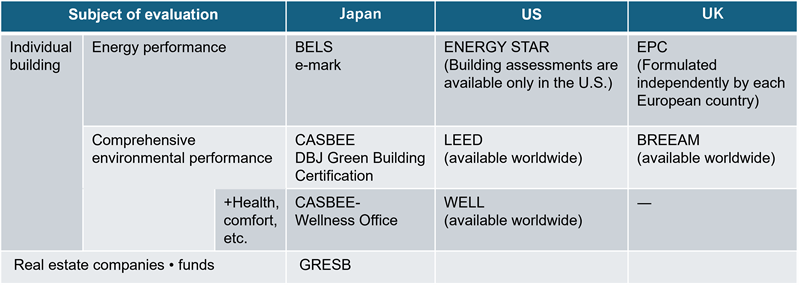
Source: Ministry of the Environment “ZEB PORTAL” website (https://www.env.go.jp/earth/zeb/detail/09.html)
BELS
Building-Housing Energy-efficiency Labeling System
BELS (Building Energy Efficiency Labeling System) is a labeling system for the energy efficiency performance of buildings that was launched in 2014. Under Article 7 of the Building Energy Conservation Act, businesses engaged in the sale or leasing of buildings are required to display the building’s energy efficiency performance, and the guidelines established by the Ministry of Land, Infrastructure, Transport and Tourism (MLIT) position BELS as an example of third-party certification.BELS evaluates energy performance at the design stage using an indicator called BEI, and assigns a rating on a five-star scale based on that value; the higher the performance, the more stars are awarded.
e-Mark
The e-Mark (Energy Conservation Standard Compliance Certification Mark) is a labeling system that indicates that an existing building complies with energy conservation standards. Like BELS, the e-Mark is designated in the energy efficiency labeling guidelines established by the Ministry of Land, Infrastructure, Transport and Tourism (MLIT) as a system for displaying the energy efficiency performance of existing buildings. It indicates compliance with energy conservation standards and does not include a ranking system.
CASBEE
Comprehensive Assessment System for Built Environment Efficiency
CASBEE (Comprehensive Assessment System for Built Environment Efficiency) is an evaluation system developed in 2001 under the leadership of the Ministry of Land, Infrastructure, Transport and Tourism (MLIT). Its scope ranges widely from individual buildings to entire cities, and the tools categorized according to the evaluation subject are collectively referred to as the “CASBEE Family.” A key feature of CASBEE is that it clearly distinguishes and treats two evaluation axes: environmental load (L) and environmental quality (Q).Based on the value of the BEE (Building Environmental Efficiency) index—where L is the denominator and Q is the numerator—buildings are ranked on a five-tier scale ranging from C (Poor) to B-, B+, A, and S (Excellent). Since 2019, the CASBEE-Wellness Office certification program has been in effect, expanding the environmental quality (Q) evaluation criteria to place greater emphasis on health.
LEED
Leadership in Energy and Environmental Design
LEED is a system developed by the U.S. non-profit organization USGBC to evaluate the comprehensive environmental performance of buildings. The scope of evaluation ranges widely from individual buildings to entire cities, with six different certification categories depending on the subject. Evaluation criteria, known as credits, are set for each category, and the total points earned determine the rating on a four-tier scale: CERTIFIED (Standard Certification), SILVER, GOLD, and PLATINUM.
WELL
WELL is an environmental certification system focused on health and comfort, established by the U.S. non-profit organization IWBI. Its evaluation criteria focus on human health and comfort, and it is characterized by being verified not only from an environmental engineering perspective but also from a medical standpoint. The evaluation criteria consist of 10 concepts. Each concept is divided into multiple evaluation items, and after meeting all mandatory requirements, a building is rated at one of three levels—Silver, Gold, or Platinum—based on the number of points earned by meeting a certain threshold of bonus items.
[Reference]
Ministry of the Environment “ZEB PORTAL” website
(https://www.env.go.jp/earth/zeb/detail/09.html)